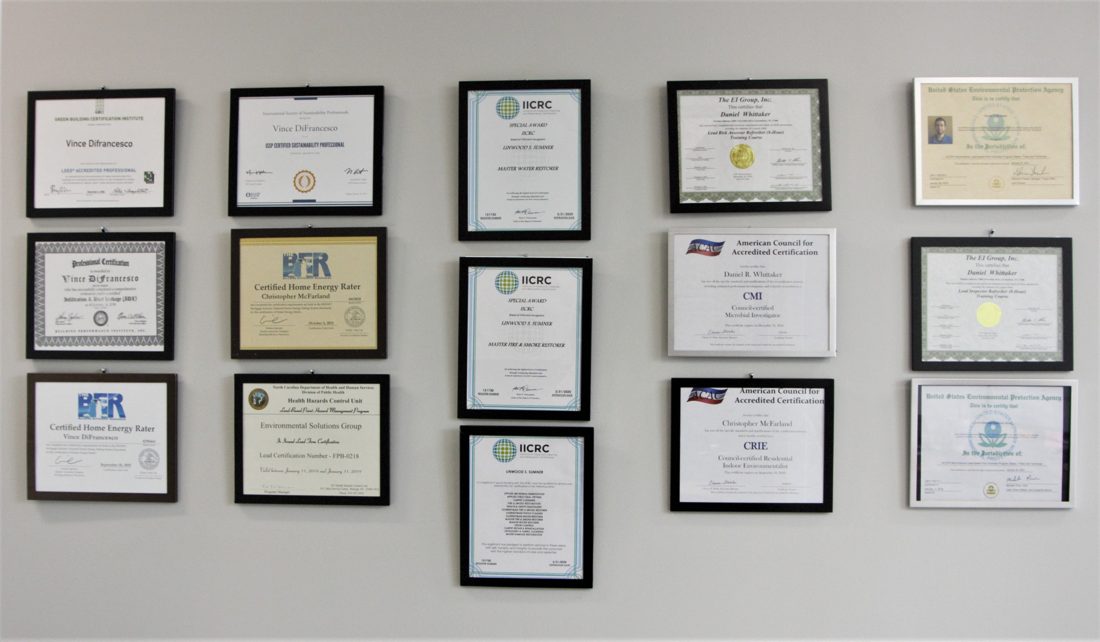
Credentials on the wall. Standards in the field.
Call us or book online. Every report reviewed by a certified CIEC consultant.
336-373-1538Our credentials aren't just letters after a name. They represent hundreds of hours of training, documented field experience, rigorous written examinations, and an ongoing commitment to continuing education in a field that keeps evolving.
These credentials are earned through examinations, documented field experience, or regulatory compliance, depending on the credentialing body, not purchased or self-declared.
Certifications aren't permanent: they require documented continuing education to maintain, ensuring our team stays current with industry developments.
Certified professionals follow published protocols, producing documentation built to stand up to scrutiny in legal, regulatory, and insurance contexts.
These certifications are individual, board-awarded credentials. Each one is attached to the ESG team member who holds it.
The CIEC is widely regarded as the premier credential for indoor environmental quality professionals. It validates a comprehensive understanding of IAQ assessment, sampling methodology, moisture investigation, and report writing.
The CIAQM designation recognizes professional knowledge of indoor air quality data, documentation, and program management. At ESG it supports the careful technical review and clear reporting behind every investigation.
The CRIE is a board-awarded credential recognizing professional knowledge of indoor environmental conditions, investigative practices, building systems, and occupant health considerations in residential settings.
An individual certification in blower door and duct leakage testing. It covers airflow, pressure relationships, duct systems, and building-envelope performance, the measurements behind ESG's duct leakage and infiltration testing work.
IICRC certification aligns ESG's inspection and assessment practices with the globally recognized S520 Standard for Professional Mold Remediation, the same standard leading remediation contractors reference when evaluating the adequacy of work performed.
EPA Lead-Safe Certified Firm: ESG is certified by the EPA under the Renovation, Repair and Painting (RRP) Rule, confirming our compliance with federal lead-safe work practices. The RRP Rule applies mainly to renovation, repair, and painting work that disturbs paint in pre-1978 housing and child-occupied facilities, with certain dust-sampling provisions.
Licensed Lead Inspector, NC: State licensure from the North Carolina Division of Public Health is required for lead inspection and risk assessment in pre-1978 residential properties and child-occupied facilities. ESG holds this license, meaning our lead testing reports meet North Carolina licensing standards and are built to stand up to scrutiny.
In many states, including North Carolina, there are no minimum licensing requirements to call yourself a mold inspector or indoor air quality tester. Credentials are how you tell the difference.
Anyone can purchase a mold test kit at a hardware store and call themselves an inspector. The presence or absence of professional certifications is often the only publicly verifiable way to distinguish a trained environmental professional from someone with no formal qualifications at all.
The credentials held across ESG's team (CIEC, CIAQM, CRIE, BPI Infiltration and Duct Leakage, EPA Lead-Safe, and IICRC) represent formal examinations, documented field experience, regulatory compliance, and ongoing continuing education, depending on the credentialing body. They are not honorary titles or pay-to-display badges.
Beyond individual qualifications, ESG's independent structure means our team has no financial incentive to find problems. We have nothing to sell you after the test is complete. That combination of certified expertise plus zero conflict of interest is rare, and it's the foundation of every report we deliver.
ESG is affiliated with and accredited by recognized professional organizations that hold their members to published ethical and technical standards.
Accredited Business with an A+ rating. Reflects our commitment to transparent business practices and responsive client service since our founding.
The ACAC is the credentialing body behind the CIEC, CIAQM, and CRIE certifications. ESG team members participate in ACAC continuing education and uphold its Code of Ethics.
The Institute of Inspection, Cleaning and Restoration Certification sets the globally recognized S520 standard for mold remediation that ESG's inspection work references.

ESG's testing protocols follow published, peer-reviewed methodologies. That means our methods aren't proprietary or invented in-house: they're drawn from established scientific literature and industry standards that can be independently verified and reproduced.
This matters most when results end up in front of a judge, an insurance adjuster, or a regulatory agency. Peer-reviewed methodology means any qualified professional can evaluate our methods, confirm our procedures were correct, and stand behind our findings.
Every sampling method follows established, published standards: ANSI/IICRC S520, EPA reference methods, AIHA guidelines, and other recognized sources.
All samples are analyzed by AIHA-accredited or equivalent third-party laboratories, not processed in-house, where results could be influenced.
Every ESG report is independently reviewed by a certified CIEC consultant before it reaches the client. No report leaves with a single reviewer's sign-off.
ESG's documentation is built to stand up to scrutiny in legal, insurance, and regulatory matters. Our experts are available to testify as qualified witnesses when needed.
Independent testing. Independently reviewed reports. Certified professionals with no conflict of interest. Call us to discuss your situation, no obligation.
Call 336-373-1538 · Mon-Fri 8:30am-5pm · Greensboro, NC