Home/Service Areas/Raleigh & the Research Triangle
Research Triangle · Wake & Durham Counties

Commercial Mold and Indoor Air Quality Consulting in Raleigh and the Research Triangle

Environmental Solutions Group provides independent mold, moisture, and indoor air quality consulting for research, university, healthcare, and commercial buildings across the Research Triangle, along with large and custom homes.

ESG evaluates conditions, documents what was measured and where, interprets the evidence, and can independently verify corrective work after remediation. ESG does not perform remediation, which is what makes the documentation usable by every party to a project.

Defensible written findings and limitationsAccredited laboratory analysisCoordination across facilities, risk, and contractors

ESG does not maintain a Raleigh, Durham, or RTP office. Triangle projects are served from the company’s Greensboro headquarters.

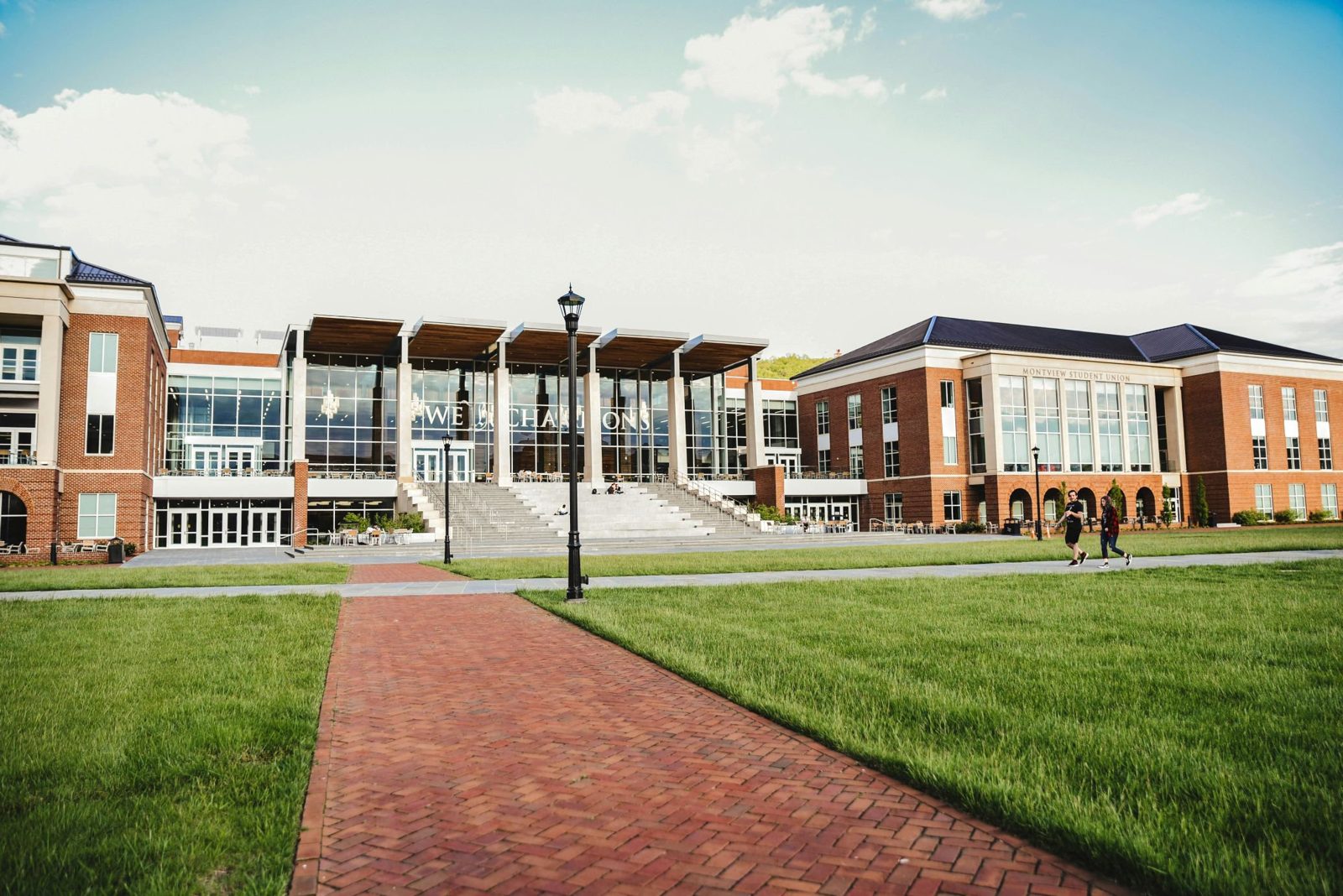
A university campus quad with brick academic buildings, a glass-fronted student union, and walkways crossing an open lawn.

The people who have to act on the answer

In the Triangle, the person who calls is rarely the only person who has to be satisfied by the answer. Facilities raises the issue, risk and legal read the report, a contractor prices the work, and someone in leadership explains it to occupants. ESG writes for all of them.

Universities and colleges

Facilities, EHS, housing, and capital projects staff working through dorm complaints, classroom water events, and multi-building systems that were not all built in the same decade.

Life sciences and research laboratories

Teams responsible for process-sensitive space where ventilation, humidity, odor, and VOC questions carry consequences beyond comfort.

Healthcare and medical facilities

Facilities, operations, and risk leadership needing environmental building assessment and documentation after moisture events, without medical conclusions attached.

Technology campuses and RTP tenants

Real estate, construction, and facilities groups managing renovations, tenant fit-outs, and LEED documentation.

Commercial offices and multifamily

Owners and managers handling tenant complaints and water damage where the written record is going to be read by more than one company.

Attorneys, insurers and owner representatives

Parties who need environmental findings that state their own limits and were produced by someone with no stake in the remediation contract.

What ESG provides in this region

Each service below is summarized here and detailed on its own page. Purpose, the work performed, the deliverable, and how the information helps you decide.

Commercial & Large-Property Mold Assessment

Written so that facilities, risk, and outside counsel can all read the same document without a translation layer.

Purpose
Determine whether visible growth, moisture sources, or hidden concerns are affecting the property, and define practical next steps.
What ESG does
Building-focused visual assessment, moisture scanning, temperature and relative humidity readings, particle and IAQ screening as appropriate, targeted laboratory sampling, and photographs.
Deliverable
Written findings and practical recommendations. A detailed technical report or remediation protocol is a separate project-specific deliverable when project goals require it.
Why it helps
The owner or facility team learns what the evidence supports, what it does not, and which next step is worth the money.
Mold Assessment

Healthy Building / Indoor Air Quality Evaluation

The usual Triangle starting point when a complaint spans a lab, a floor, or a wing and no single sample will settle it.

Purpose
Evaluate building conditions and indoor air quality patterns instead of relying on a single measurement or a single sample.
What ESG does
Visual building review, moisture evaluation, and measurement of temperature, relative humidity, carbon dioxide, total volatile organic compounds, and particles, with targeted fungal, VOC, or allergen testing as needed.
Deliverable
A clear summary of findings, the conditions likely contributing to them, and recommended actions or further evaluation.
Why it helps
Occupant complaints get answered with building data rather than guesswork, and the response can be aimed at the actual contributing condition.
Healthy Building Assessment

Remediation Planning & Technical Protocol

Defined objectives and PRV criteria in writing, which is what lets a university or health system put a remediation scope out to more than one contractor.

Purpose
Translate assessment findings into a clear project objective and written criteria for remediation and verification.
What ESG does
Review of project evidence, definition of the affected areas, and written cleaning and removal objectives, containment considerations, documentation expectations, and PRV criteria when appropriate.
Deliverable
A project-specific technical report and/or remediation protocol, prepared and reviewed by qualified ESG professionals.
Why it helps
Contractors bid against the same defined scope, so proposals can be compared on price and method instead of interpretation.
Assessment & Technical Reporting

Independent Scope Review & Remediation Project Support

Independent review of contractor scopes and estimates, plus attendance at project meetings when discoveries change the picture.

Purpose
Help owners evaluate high-cost or complex remediation proposals and stay informed as the work proceeds.
What ESG does
Review of contractor scopes and estimates, comparison of proposals against the documented findings, attendance at meetings or site reviews, and clarification of project criteria as discoveries come up.
Deliverable
Written review comments, consultation, project records, or protocol updates as authorized. The contractor remains responsible for means, methods, worker safety, permits, and code compliance.
Why it helps
The owner has someone reading the scope who is not being paid to perform the work described in it.
Remediation Project Support

Post-Remediation Verification (PRV) / Clearance Testing

Independent evaluation of the defined remediation area against the project criteria, at the time of evaluation.

Purpose
Independently determine whether the defined remediation area meets the project acceptance criteria at the time of evaluation.
What ESG does
Visual cleanliness review, moisture and odor evaluation, particle screening, appropriate air and/or surface sampling, and review of the defined project criteria.
Deliverable
A written PRV determination or report identifying acceptable conditions or the corrective actions still needed.
Why it helps
Re-occupancy and final payment rest on an independent evaluation of the defined work area rather than on the remediator’s own sign-off.
Post-Remediation Verification

Ongoing IAQ Checkpoints / Indoor Air Wellness Program

Recurring checkpoints and trend data, which institutions tend to need more than one-time testing because the questions come back every semester.

Purpose
Establish repeatable checkpoints and trend data for schools and commercial buildings instead of testing only after a complaint.
What ESG does
A representative sampling strategy, periodic fungal, carbon dioxide, and relative humidity measurements with optional particle, carbon monoxide, or TVOC readings, plus monitoring or seasonal baselines and staff consultation.
Deliverable
Recurring reports, trend interpretation, communication support, and a plan built around the organization.
Why it helps
Leadership can answer occupant questions from a record built over time rather than from a single visit.
Indoor Air Wellness Program

LEED Indoor Air Quality Testing & Documentation

Independent IAQ testing and documentation for registered LEED projects, including LEED v4.1 projects, common across RTP and campus construction.

Purpose
Provide independent testing and documentation for the project’s registered LEED rating system and its selected Indoor Air Quality Assessment pathway, including LEED v4.1 projects.
What ESG does
A project-specific sampling plan, environmental sample collection, accredited laboratory analysis, review of the required parameters and thresholds, and coordination with the LEED project team.
Deliverable
Testing records and reporting suitable for project submittal.
Why it helps
The credit documentation comes from an independent party, and the scope is confirmed against the registered rating system before testing begins.
LEED IAQ Testing

Facility Team Training & Communication Support

Practical instruction for maintenance and facilities teams, including how to communicate what testing can and cannot establish to occupants.

Purpose
Give maintenance, facilities, management, and communication teams a common process for recognizing, documenting, escalating, and explaining mold and IAQ concerns.
What ESG does
On-site, classroom, virtual, or project-specific instruction covering moisture and mold recognition, IAQ fundamentals, documentation, PRV readiness, and how to communicate what testing can and cannot establish.
Deliverable
Customized training, workshop materials, handouts, and follow-up consultation for the organization.
Why it helps
Small moisture problems get caught and documented by staff before they turn into capital-expense problems.
Consultation & Training

Why independent third-party involvement matters

ESG assesses, documents, interprets, recommends, and verifies. ESG does not perform remediation. That is a structural fact about the company, not a marketing position, and it is the reason the findings can be used by every party to a project.

When the company that evaluates a building is also the company that would be paid to correct it, every finding carries a commercial incentive. On a large or complex project that incentive is worth removing, both for the owner writing the check and for the contractor whose completed work will be judged by someone with nothing to gain from the verdict.

It also changes what the report is allowed to say. ESG documents conditions in the areas assessed at the time of evaluation, states the limitations of the work, and leaves health questions to a qualified medical provider.

No
remediation work performed by ESG
3rd
party to the owner and the contractor
2002
year ESG was founded, in Greensboro
1
defined remediation area per PRV determination

Five steps, in the order they actually happen

1

Define the question

ESG confirms the property, the concern, the project history, how the findings will be used, and the appropriate scope of work.

2

Evaluate the building

A qualified ESG professional observes conditions, collects measurements, and selects targeted samples or monitoring based on the project.

3

Interpret and document

ESG reviews the field and laboratory evidence and provides clear findings, the limitations of those findings, and practical next steps.

4

Support the decision

When authorized, ESG can prepare a protocol, review contractor scopes, attend project meetings, or clarify discoveries as the work proceeds.

5

Verify corrective work

After remediation, ESG can perform independent PRV of the defined work area using the applicable visual, moisture, odor, field, and laboratory criteria.

Where ESG works in the Research Triangle

Primary service geography

ESG serves projects across Wake, Durham, Orange, Chatham, and Johnston counties as routine coverage from its Greensboro headquarters.

Case-by-case coverage

Franklin, Granville, Harnett, and Lee counties are handled case by case. The official Research Triangle regional footprint reaches further than this, and ESG would rather name the area it actually covers routinely.

Communities served

Raleigh Cary Apex Holly Springs Fuquay-Varina Morrisville Wake Forest Garner Durham Chapel Hill Carrboro Hillsborough Pittsboro Clayton Research Triangle Park
Headquarters: 7 Maple Leaf Drive, Ste 104, Greensboro, NC 27410. 336-373-1538
ESG does not maintain a Raleigh, Durham, or RTP office. Triangle projects are served from the company’s Greensboro headquarters.

Where the report has to survive several readers

Research, university, healthcare, and technology organizations in the Triangle share a specific requirement: the environmental findings will be read by people who did not attend the site visit and who have different reasons for reading. Facilities wants to know what to fix. Risk wants to know what was and was not established. A contractor wants a scope. Communications wants language that is accurate in front of occupants.

That shapes how ESG documents a Triangle project. Measurements are recorded with their locations and the conditions at the time of evaluation. Field screening is kept distinct from laboratory identification. The limits of the work are written into the report rather than left to be inferred. When a finding is not supported by the evidence, the report says so.

Residence halls and classroom buildings where the complaint arrives before the water source is known
Laboratory and process-sensitive space where ventilation and humidity questions are not comfort questions
Renovations and tenant fit-outs across RTP with LEED documentation running in parallel
Projects where facilities, risk, legal, and a contractor all work from one written scope
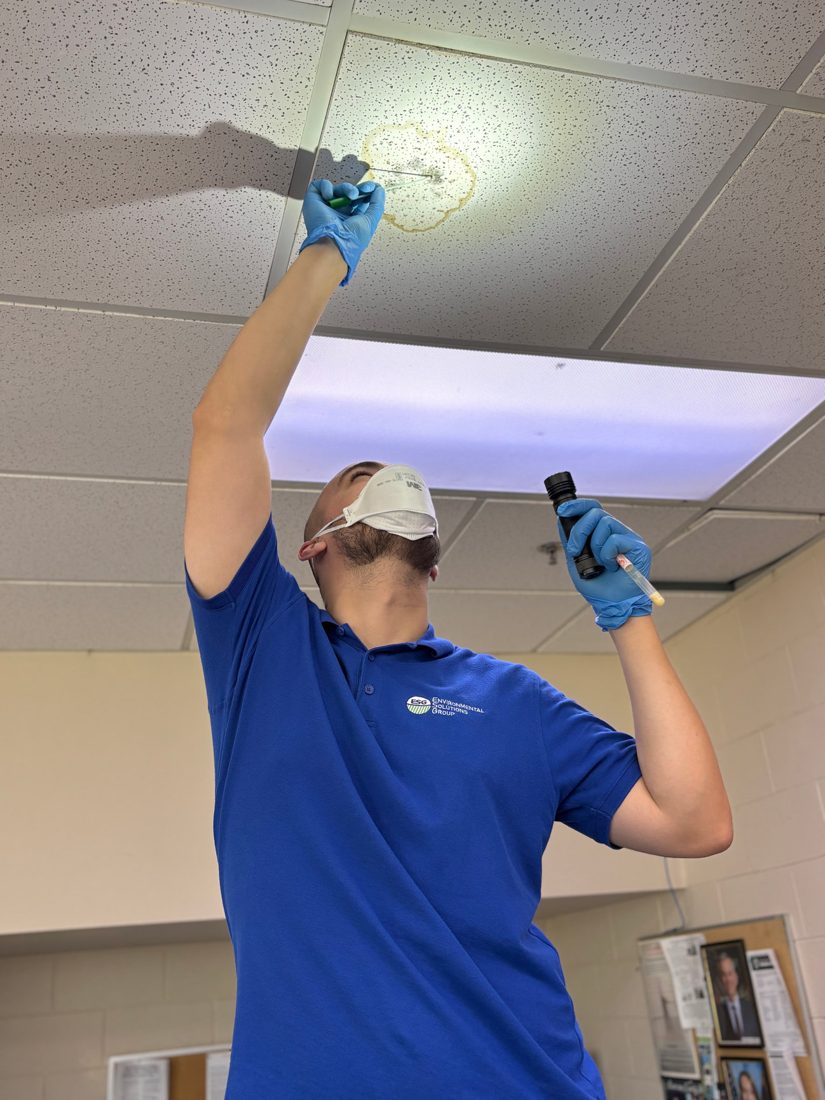
An ESG technician in a blue company polo reaches up to collect a sample from a water-stained ceiling tile in an institutional building.

Frequently asked

Our facilities, risk, and legal teams all need to read the findings. How does ESG write a report?

The report states what was observed, what was measured and where, what the laboratory identified, and what the evidence does and does not support. Real-time field screening is kept separate from laboratory identification, and the limitations of the work are written into the document rather than left to be inferred by whoever reads it last.

Can ESG evaluate laboratory or process-sensitive space?

Yes, as an environmental building evaluation: ventilation, moisture, temperature and relative humidity, carbon dioxide, TVOC, particles, and targeted sampling selected for the specific question. ESG assesses the building environment. It does not certify process suitability or make clinical determinations.

A residence hall has a complaint but no visible water source. Where does that start?

With a Healthy Building / IAQ evaluation rather than a single sample. Complaints that span rooms, floors, or a wing are usually about a contributing building condition, and one air sample in one room tends to produce a number without a direction.

Does ESG handle LEED indoor air quality testing for RTP and campus projects?

Yes, including LEED v4.1 projects. The sampling plan, parameters, thresholds, and submittal requirements are confirmed against the project’s registered rating system and selected Indoor Air Quality Assessment pathway before testing is scheduled, because those requirements differ by project.

Can ESG stay involved during the remediation rather than only before and after?

Yes, when the project authorizes it. That can include reviewing contractor scopes, attending project meetings or site reviews, addressing discoveries as they come up, and updating the protocol. The contractor remains responsible for means, methods, worker safety, permits, and code compliance.

What happens if the assessment does not find what we expected?

The report says so. A finding that the evidence does not support a suspected condition is a legitimate and frequently valuable result, particularly when the alternative was an expensive scope of work aimed at the wrong thing.

What stands behind the findings

Independent by structure

ESG assesses, documents, interprets, consults, and verifies. ESG does not perform remediation, so no finding is tied to selling the repair that follows it.

Accredited laboratory analysis

Samples are analyzed by accredited laboratories, and the reporting distinguishes real-time field screening from laboratory identification.

Calibrated field instruments

Moisture meters, particle counters, and IAQ instruments are maintained and calibrated, and the readings are recorded with the conditions at the time of evaluation.

Reviewed before it goes out

Findings are reviewed by qualified ESG professionals before the report is issued, and the limitations of the work are stated in the report itself.

ACAC accredited certification Indoor Air Quality Association member EPA lead-safe certified firm North Carolina Healthy Homes Specialist North Carolina energy and building program
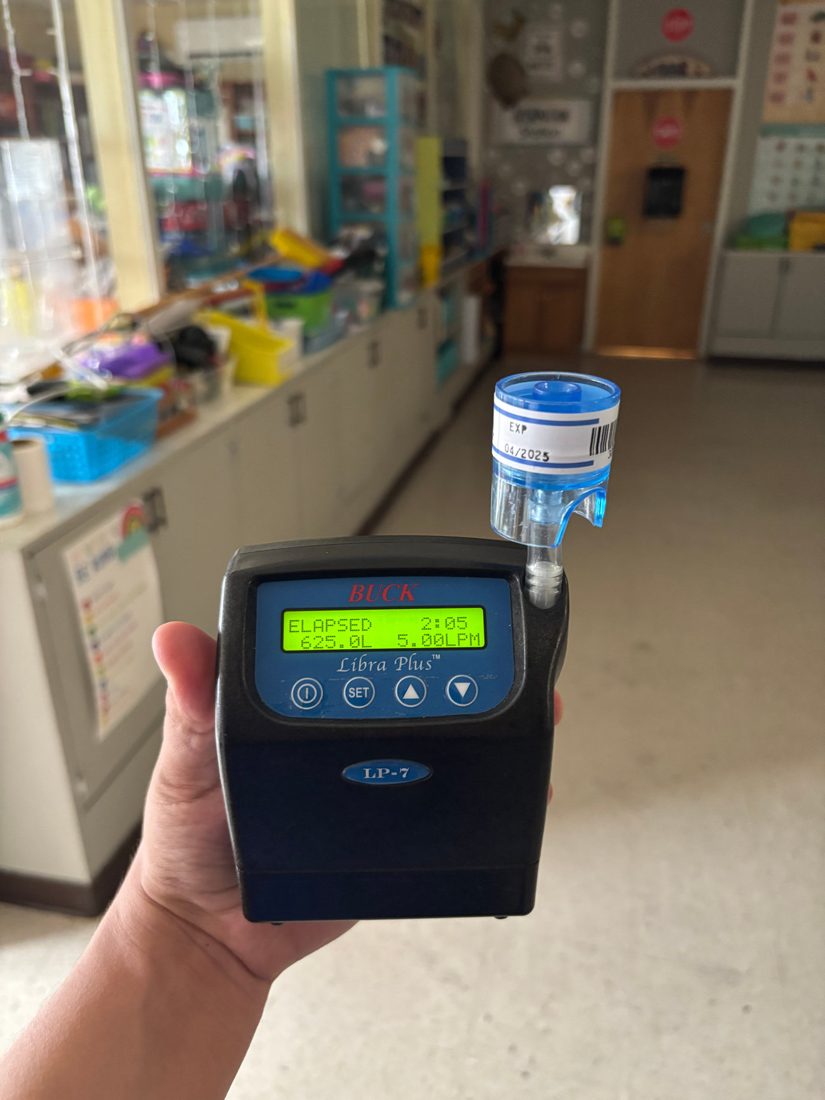
A hand holds a portable air sampling pump fitted with a spore trap cassette inside an occupied classroom.
Air sampling in an occupied classroom, recorded with the conditions at the time of evaluation.

Discuss a Triangle building or campus project

Bring the building, the concern, the stakeholders who need to read the outcome, and the deadline. ESG will describe an appropriate scope and what the resulting documentation will and will not establish.

336-373-1538 · environmental@go-esg.com · Greensboro, NC